Esther Badu
Position title: Cohort 10 Scholar
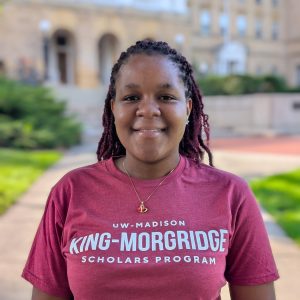
Hometown: Kumasi and Aflao, Ghana
Major: Textile and Fashion Design
Questions and Answers:
What is a fun fact about your hometown?
- Kumasi has The Immovable Sword. The city houses the legendary Komfo Anokye sword site, where a mystical iron sword stuck into the ground centuries ago has reportedly never been budged by anyone. Aflao is right on the Border. It sits directly next to Lomé, the capital of Togo, making it one of Ghana’s most active international trading gates.
What are you looking forward to doing during your degree at UW-Madison?
- I’m looking forward to joining the Apparel and Textile Association (ATA) as well as the Rewear It club that promotes sustainable fashion. I’m equally excited to experience life beyond the classroom. I’ve never experienced snow before, so I’m looking forward to building my first snowman, trying ice skating or skiing, and seeing what a Wisconsin winter is really like. I also can’t wait to attend a Badgers football game at Camp Randall and experience the school spirit everyone talks about. As someone who loves cooking, I’m excited to try Wisconsin cheese curds and other local foods, explore farmers’ markets, and even take weekend trips to Chicago with friends. Most of all, I’m looking forward to meeting people from different cultures and creating memories that will stay with me long after graduation.
Why do you believe that the King-Morgridge Scholars Program at UW-Madison is important to the institution, state, and world?
- I believe the King-Morgridge Scholars Program embodies the Wisconsin Idea by investing in students who are committed to creating change far beyond campus. The program brings together scholars from different countries, cultures, and experiences, creating a community where ideas are challenged, shared, and strengthened. Its impact extends beyond Wisconsin because scholars return home equipped with the knowledge, networks, and confidence to tackle issues such as climate change, healthcare, education, and economic inequality. For the institution, it attracts students driven by purpose rather than privilege. For Wisconsin, it strengthens a global network of leaders connected to the university. For the world, it creates a ripple effect: one scholarship becomes countless acts of service, innovation, and leadership across communities and generations.
Are there specific issues in poverty alleviation or development that you would like to work on or are currently addressing?
- I am passionate about tackling the interconnected challenges of environmental pollution, youth unemployment, and economic inequality. Growing up in Ghana, I have seen how plastic and textile waste contribute to flooding, damage marine ecosystems, and threaten the livelihoods of local tailors, retailers, and fishing communities. Through Sankofa Fashion House, I began exploring how entrepreneurship can transform environmental challenges into economic opportunities by recovering and repurposing discarded clothing while creating income for local artisans. Beyond this work, I want to explore how research, policy, and innovation can help communities build more resilient local economies. Whether I ultimately work in sustainability, public policy, or another field, my goal is to develop solutions that create jobs, reduce environmental degradation, and expand opportunities for underserved communities across Ghana and Africa.
What do you like to do in your free time?
- In my free time, I enjoy learning Korean on Duolingo—it started as a fun challenge and has become part of my daily routine. I also love trying out new recipes in the kitchen and experimenting with different cuisines. When I’m ready to relax, you’ll probably find me watching sitcoms, rom-coms, or MSA anime, reading a good book, or spending time with friends. I also enjoy redesigning old clothes into something new and unique because I love the creative challenge of giving them a second life.