Julia Maryling Taiz Taboada Valdez
Position title: Cohort 10 Scholar
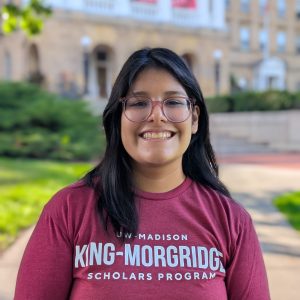
Hometown: Lima, Peru
Major: Biology
Questions and Answers:
What is a fun fact about your hometown?
- Around my hometown, there are many Peruvian-Chinese restaurants. We call them “chifas,” and they serve delicious food. Most people speak Spanish, but it is also common to hear Quechua and Chinese spoken by some neighbors and people on the streets. Quechua is an Indigenous language from the Peruvian highlands. In recent years, many people have moved from the highlands to Lima, my hometown, so it has become more common to hear Quechua in everyday life. The same has happened with the Chinese community, which has become an important part of the city’s culture.
What are you looking forward to doing during your degree at UW-Madison?
- When I was a kid, I used to go ice skating, and I fell in love with the sport. Unfortunately, the skating rink closed because of a lack of support, so I couldn’t continue practicing. I’m looking forward to going ice skating again someday!
Why do you believe that the King-Morgridge Scholars Program at UW-Madison is important to the institution, state, and world?
- I believe the King-Morgridge Scholars Program is important because it invests in people who are already committed to making a difference. Many scholars I have met before shown leadership and created positive change in their communities long before college, and KMSP gives them the support and opportunities to continue growing. By bringing together talented, low-income students from around the world, UW–Madison strengthens its mission and builds a community of future leaders. I strongly believe the program’s impact goes far beyond the university, as its scholars use what they learn to improve their communities and inspire others to do the same.
Are there specific issues in poverty alleviation or development that you would like to work on or are currently addressing?
- I would like to work on using synthetic biology with fungi and other microorganisms to protect soils in rural communities and develop bioremediation solutions for contaminated land. I believe this approach could help communities preserve their land and use it more sustainably for agriculture and everyday life.
I have already explored this idea through independent research on fungi and their environmental applications. At UW–Madison, I hope to gain hands-on experience in a fungi or synthetic biology laboratory so I can strengthen my research skills and turn these ideas into projects that can make a real impact.
What do you like to do in your free time?
- I really enjoy playing the flute. I usually practice my repertoire in the late afternoons and focus on technique during the weekends. When I’m not playing music, I’m usually dancing. I love learning K-pop choreographies!